
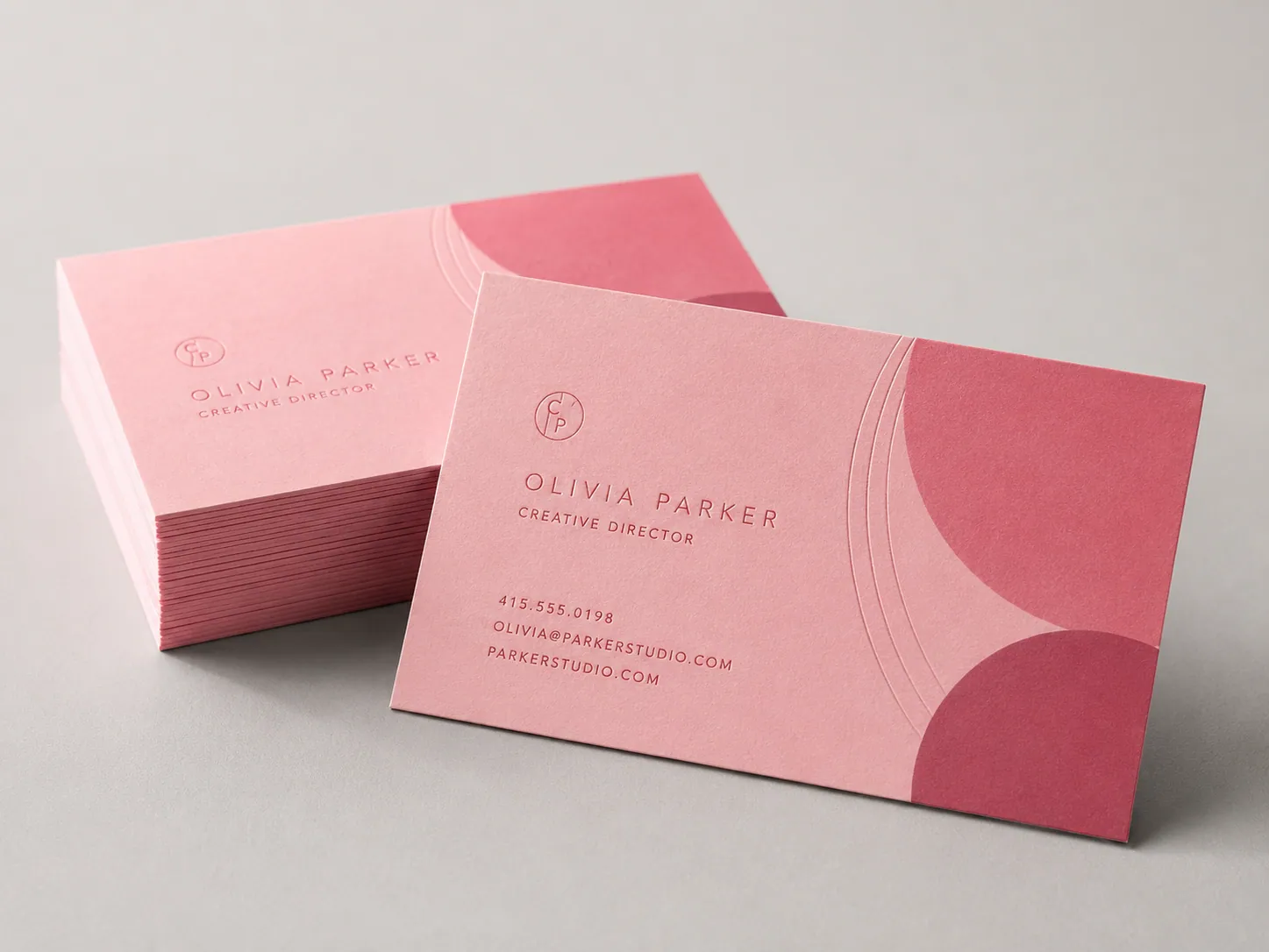
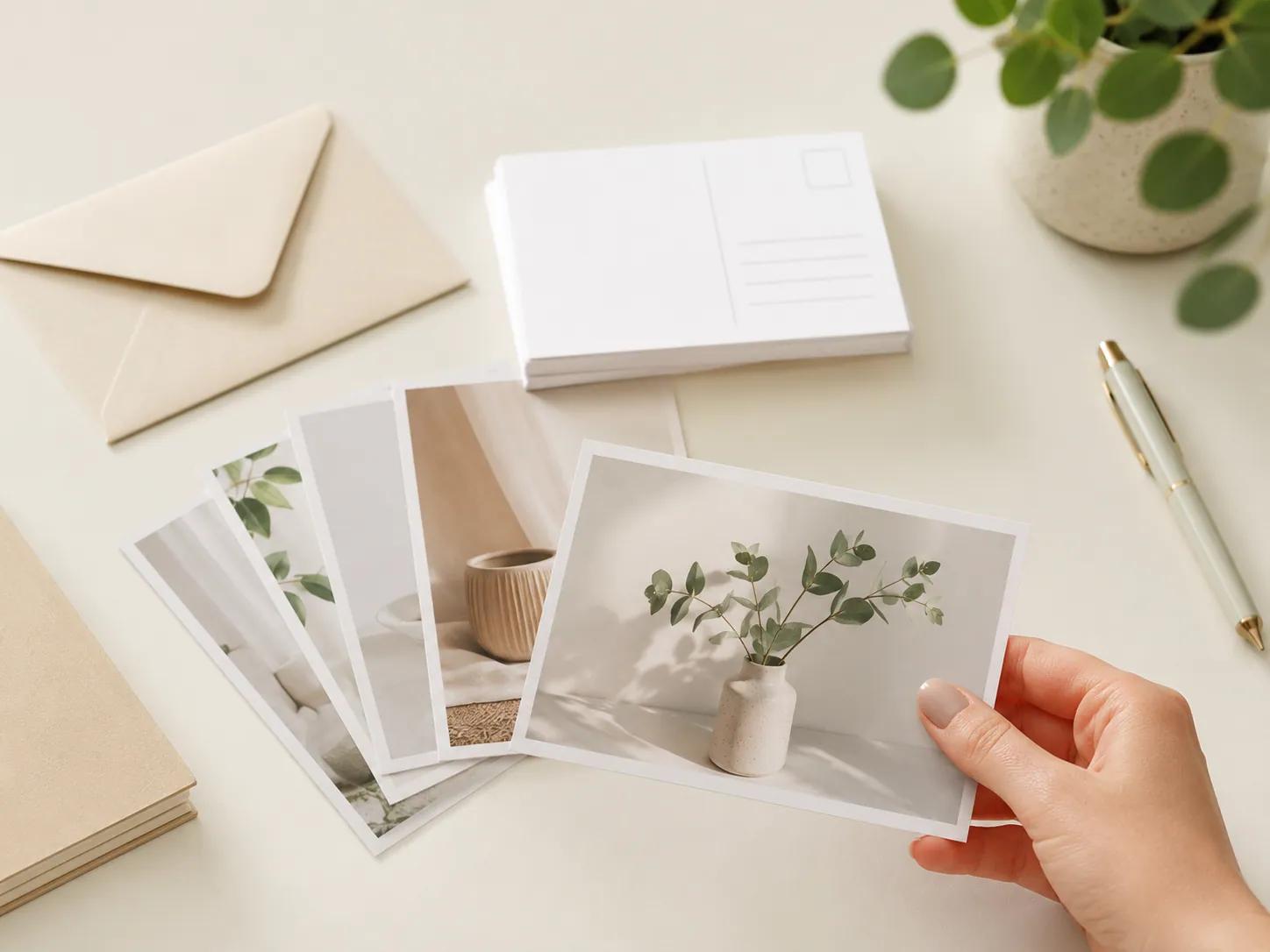
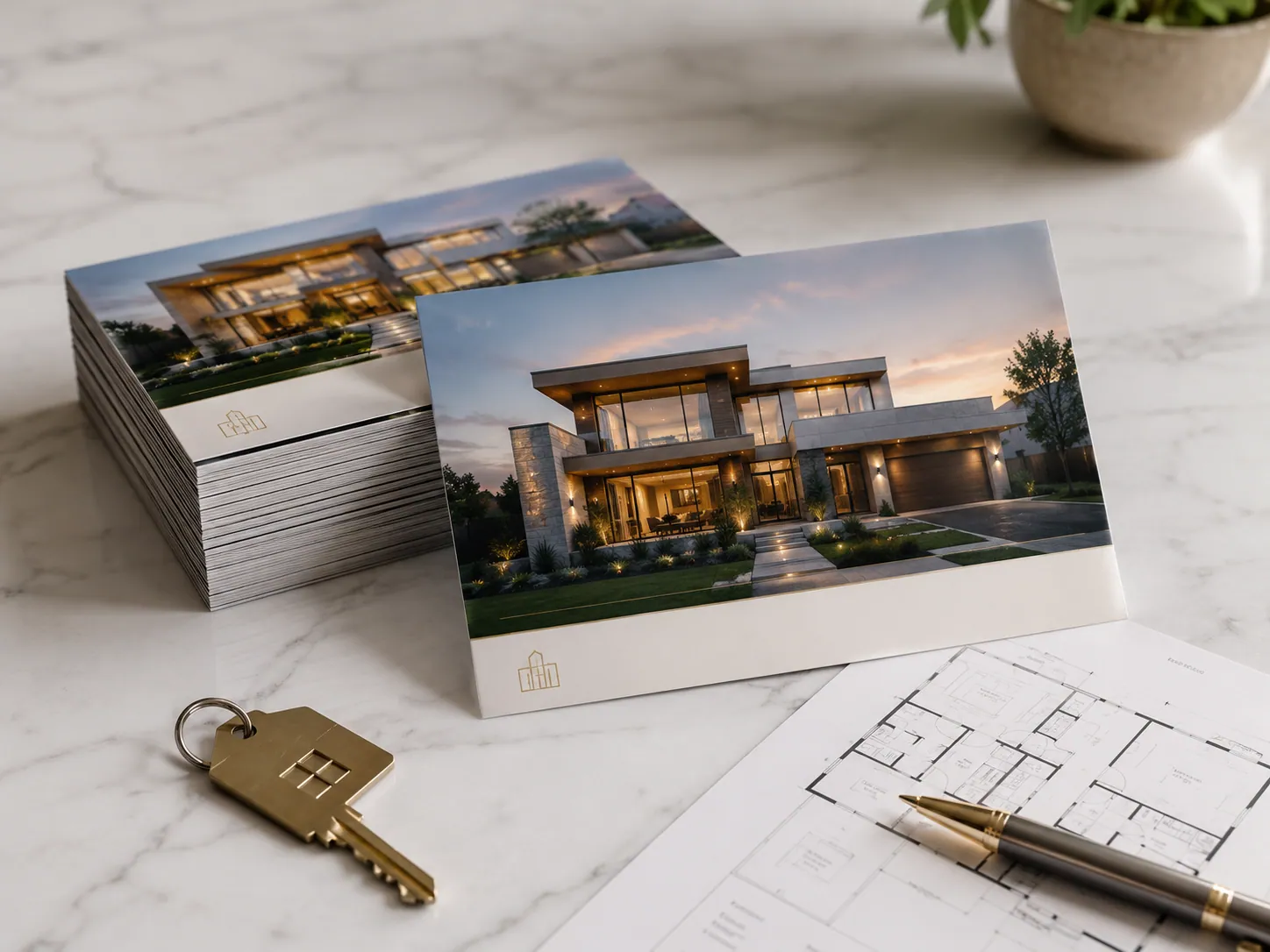





A dental office orders 2,000 appointment reminders at 4.5 x 6.5 inches, figuring a bigger card is harder to lose on a fridge. Nothing is wrong with the design. The catch comes at the post office, because at that size USPS no longer sees a postcard, and all 2,000 get billed as letters.
Under the July 2026 USPS price announcement, that’s 82 cents a card instead of 65, or $340 gone. The culprit is postcard format, meaning the size, thickness, shape and address layout that set the price on any postcard printing and mailing order.
Postcard Format Decides Your USPS Mail Class
USPS does not price mail by what a printer calls the product. It measures the piece instead. Every postcard mailing then lands in one of three groups.
The cheapest is the First-Class postcard rate, and it’s strict about size. Go bigger and you’re in the letter group, which costs more for a single card but often nothing extra in bulk. The third, Every Door Direct Mail, only takes pieces big enough to count as flats. Decide which one you’re aiming for before anyone opens a design file, and direct mail printing jobs won’t come back for a resize.
Postcard Format Limits For The 65-Cent Card Rate
Two things matter here, size and thickness, and USPS won’t give an inch on either.
Card Rate Size Limits
USPS Business Mail 101 gives you a window, with 3.5 x 5 inches at the small end and 4.25 x 6 at the big end, and the card has to be a plain rectangle. Most print shops will push you toward 4 x 6, the standard postcard size. Their reason is the cutter. A 5,000-card job can drift a hair during trimming, and that quarter inch of slack keeps the whole run legal, which is why so many offices keep reordering 4 x 6 postcards.
Card Stock Thickness Limits
Postcard thickness is the second hurdle. The Postal Service won’t give a card the postcard rate if it’s thinner than 0.007 inch, and it won’t take one thicker than 0.016 either. Printers quote stock in points, and a point is a thousandth of an inch.
At 14PT you’re comfortably in the middle of the range. 16PT is where it gets tight, because it’s already at the ceiling and a laminate or heavy coat can nudge it over. Anything sold as 18PT or 32PT won’t make it, and 20PT plastic is out twice over, since it’s too thick and it isn’t paper.
If you’re sending a USPS postcard at the card rate, 14PT or 16PT paper is the safe bet, and picking one of them handles the thickness half of USPS compliant postcard printing. A free sample pack lets you bend both before you order a full run.
Larger Postcards Follow Letter Mail Rules
Go even a little past 4.25 x 6 inches and USPS starts charging letter postage instead. USPS Marketing Mail has no separate postcard rate, so small and large cards pay the same letter price once a mailing reaches 200 pieces. In bulk postcard printing, a bigger postcard printing size adds selling space without adding postage. The postcard format can grow to 6.125 x 11.5 inches. Two more rules still apply.
Minimum Thickness For Large Cards
The first one’s a thick floor. Any card bigger than 4.25 x 6 has to be at least 0.009 inch thick, or it can’t run on the sorting machines and picks up the nonmachinable surcharge. Light cover stock is usually the culprit, since a 6 x 11 printed on it can feel stiff enough in your hand and still measure under 0.009 on a caliper. Have your printer check one before you sign off.
Aspect Ratio And Square Cards
The second rule is about shape. Divide the card’s length by its height and you need a number between 1.3 and 2.5 for the machines to handle it. Most rectangular postcard dimensions land there without anyone thinking about it. Square cards are the ones that catch designers out, because a ratio of 1.0 means a surcharge on every piece. Clients after a tall, narrow look tend to settle on a 4 x 9 postcard size once they hear it mails for no extra charge.
EDDM Postcards Must Qualify As Flat Mail
A card gets there by being longer than 10.5 inches, taller than 6.125 inches or thicker than a quarter inch, and the whole piece can’t top 3.3 ounces. A 6.5 x 9 clears it on height, a 6 x 11 squeaks through on length, and the 6 x 9 card fails all three.
You’ll need at least 200 pieces per EDDM Retail mailing, and any one Post Office will only take 5,000 of them a day. Commercial postcard printing for EDDM must also carry the EDDM Retail indicia. A lot of businesses land on 6.5 x 9 for EDDM postcards, since it clears the height rule without paying for a full 8.5 x 11 sheet.
Address Side Layout For A Mail-Ready Postcard Format
Size is only half the work. The back of the card follows its own postcard mailing rules, whatever the mail class.
Address Placement And Direction
The delivery address must run parallel to the longest edge. A portrait front is fine. Turning the address sideways to match it is not, since that makes the card nonmachinable. Keep the address inside the optical character reader (OCR) area, at least half an inch from each side and 5/8 inch to 2.75 inches above the bottom.
Barcode Clear Zone Rules
USPS keeps a strip in the bottom right corner, about 4.75 inches wide and 5/8 inch tall, so its equipment can print an Intelligent Mail barcode. Designers love running a photo bleed into that corner or tucking a QR code there, and that’s exactly what trips up the scanner. Since most postcard mailing services print the address and barcode in one go, a white corner saves everyone a reprint.
Coatings And Attachments
High-gloss UV looks great on the front, but inkjet addresses smear on it, so keep the back aqueous or uncoated. That back will take a pen too, and handwritten notes still stand out in a mailbox full of print. Stickers and magnets can knock a card off the postcard rate, so check them before any business postcard printing starts.
Five Proof Checks That Prevent Postage Surprises
Charles Eames, the American designer, once said, “The details are not the details. They make the design.” On a postcard, the details also set the postage. Before you approve the proof on any direct mail printing job, run through these five.
Measure the trimmed card and confirm the postcard printing size.
Ask for the measured postcard thickness of your exact stock.
Work out the aspect ratio and check the address direction.
Leave the barcode corner blank and keep the back inkjet friendly.
Before a big drop, have a USPS Mailpiece Design Analyst see a sample.
Multi-location brands should write these choices into one approved spec. That way nobody swaps a commercial postcard printing order to 18PT stock and gets hit with letter rates. It’s the same thinking behind keeping one print standard across every location.
Wrapping It Up
Most postcard mailing problems start in the design file, where fixing them costs nothing. Settle the mail class before anything else. Once that’s decided, the size, stock, coating and address layout pretty much follow, and USPS compliant postcard printing stops being a guessing game. With letter-size cards, run the postcard dimensions through the aspect ratio check too.
When you’re ready to print, BizCard can take care of postcard printing and mailing for anything from one neighborhood drop to a full season of bulk postcard printing. Nothing goes to press until you’ve signed off on a proof. That approved file then becomes the starting point the next time your business postcard printing comes around. Choose a postcard format that suits your mail class, send your artwork or pick a template, and get the order in today.


