

The majority of brochures are given a fast review prior to deciding if they should be read. Large brochures require much more reviewing than a busy reader can provide. Therefore, a discount on the final page may be overlooked. Smaller types will not fix this problem.
Shorter copy and an offer placed early will. Below are word limits for each panel and signs that a booklet or sell sheet fits better.
The Reader Drop-Off In Long Brochures
Brochures lose readers when the offer sits behind more text than a skimmer will process. Print starts with an edge, though. Crowded panels waste the attention print earns, along with the brochure printing budget behind them.
The Buried Offer Problem
Trifolds have a specific reading order. The first part of a trifold is the cover. After the cover, you will see the inside flap. Finally, you will see the full inside spread. Long brochures often have the company history on the inside spread, which pushes the main offer onto the back panel. A reader who stops at the flap will not be able to read the offer.
Reading Level And Attention
Adults who cannot read the dense language in some pamphlets may be able to read short, clear sentences. If those same adults are presented with a document that contains multiple levels of clauses and technical terms, they will get confused.
The improvement of the brochure's legibility can remove numerous barriers to an individual viewing the advertisement.
A Word Budget For Every Panel

Hard limits make cutting easier. On a standard 8.5 by 11-inch trifold, this budget keeps all six panels readable.
Cover panel: under 15 words for the headline, a benefit line, and the logo.
Inside flap: 40 to 60 words that sum up the offer for the target audience.
Each inside panel: 80 to 120 words on one topic under its own subhead.
Back panel: 30 to 50 words with contact details and the repeated offer.
Many long brochure print runs can exceed that by a great deal, because each service and each award is presented as a separate paragraph. For most businesses, all that is needed to produce a professional-looking brochure is a single tri-fold design that meets the above requirements.
Before the layout process begins, provide these items to the person(s) who design your brochures. A sell sheet can display the message without being folded in half if the message is short enough to fit on just one side.
Brochure Copywriting That Cuts Without Losing Meaning

As Blaise Pascal admitted in his Provincial Letters, “I have made this longer than usual because I have not had time to make it shorter.” Short copy takes more work than long copy. Four edits handle most of it.
The One-Sentence Offer Test
Write the offer as one sentence before editing anything else. “Free roof inspection for Travis County homeowners, booked by November 30” passes. “Quality roofing solutions for all your needs” fails, because it names no audience and no deadline. Any brochure content that does not support the sentence can move to the website.
Results Before Company History
Company history often opens long brochures, even though readers care about it least. Start each panel with the outcome the reader wants. “Same-week AC repair across Austin” does more work than “Founded in 1998, our family company...” Shrink the founding story to one line near the back.
Proof Points Over Adjectives
Calling a company reliable proves nothing. A state license number or a testimonial with a full name does the convincing, and it scans in a second.
Plain Language Rules
The federal plain language guidelines on Digital recommend one idea per sentence and paragraphs of no more than 150 words. Brochure panels need far less, so aim for blocks of two or three sentences. Swap “utilize” for “use” and “in order to” for “to.” Then read each panel aloud and split any sentence that runs out of breath.
Brochure Layout That Keeps The Offer In Sight

In brochure design, visual hierarchy decides what the eye meets first. Skimmers should find the offer without reading a full paragraph.
Inside Flap Placement
Readers see the inside flap first after opening the cover, which makes it the best spot for the main offer. Repeat that offer on the back panel next to the contact details.
Type, Spacing, And Folds
Set body text at 10 or 11 points with extra space between paragraphs.
Use no more than two typefaces, one for headlines and one for body copy.
Keep text at least 0.125 inch away from trim edges and fold lines.
Leave white space around the offer so it stands apart.
Strong custom brochure design applies these principles prior to any added decoration, allowing for the maximum amount of visibility for the product/service offered.
One Clear Brochure Call To Action
Each brochure must contain one primary action (i.e., call us, make an appointment). A long brochure can be confusing, as there are many options available with approximately equal weight: phone number, website address, store/showroom location, three social media links. Select the most critical action and use the largest font size for that action on each panel.
Every dollar that you use for printing brochures should produce some form of measurable progress. This guide about how to print flyers so they act as lead generators will help you determine which of your printed items are producing results in terms of phone calls.
Moving Long Brochures Into Booklets And Sell Sheets
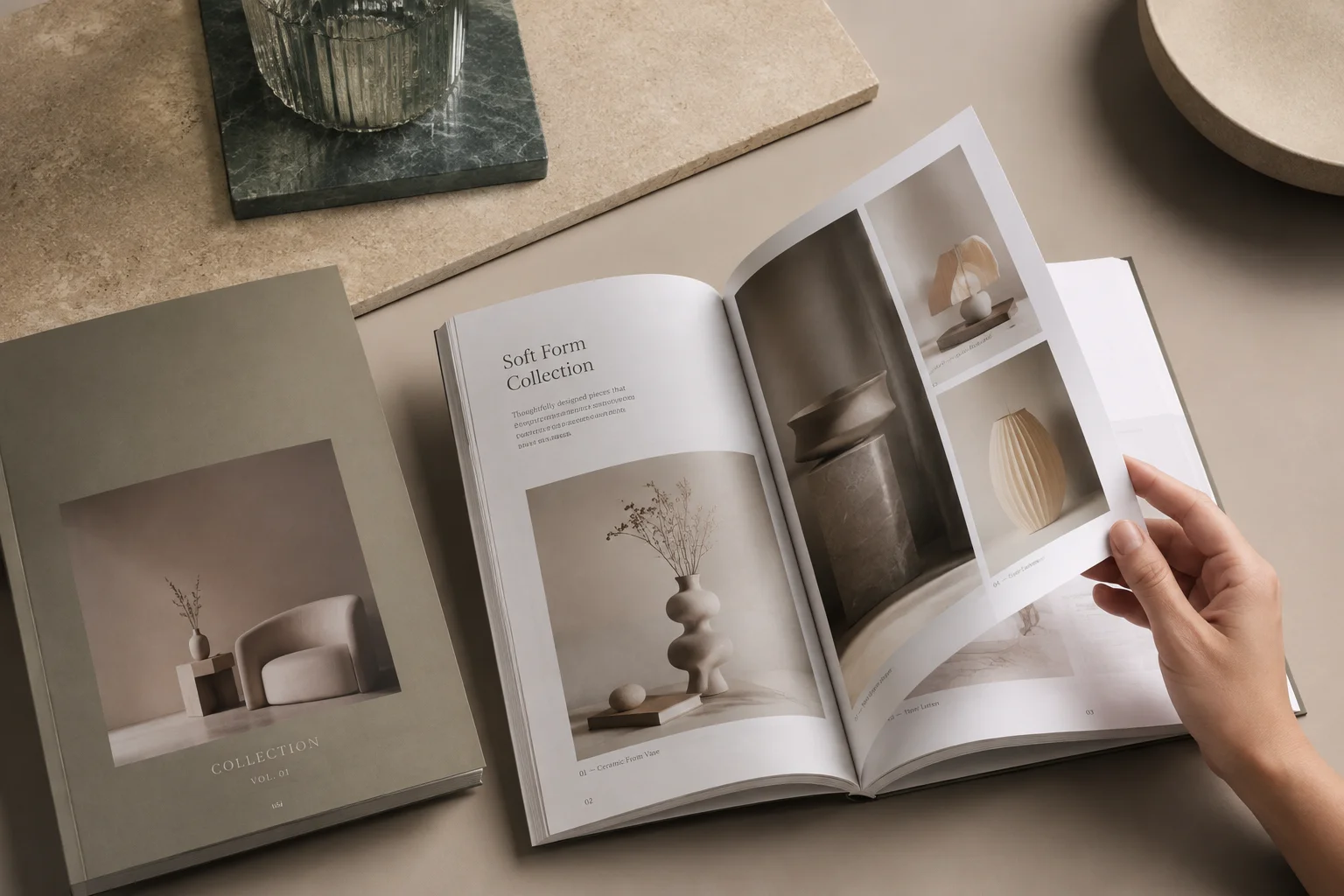
Some products need room. Dental offices explaining implant options cannot fit the details on six panels, and no amount of brochure copywriting will change that. Splitting the message works better than shrinking the type.
Service menus, specifications, and detailed FAQs move into a booklet.
The offer and its key benefits go on a sell sheet for trade shows.
The short trifold becomes the piece people pick up first.
The strongest brochure marketing solutions give each piece one job. Sales teams use the same idea in B2B sales kits, where a short leave-behind opens the conversation and longer pieces answer follow-up questions.
Conclusion
Long brochures rarely fail because of the product. They fail because the offer sits behind too many words. A word budget, an early offer, and a five-second test fix most of that before anything goes to bulk brochure printing.
The process of copy and custom brochure design has come to an end, and now BizCard is the brochure printing company that can assist you with the final stage. All of our brochures are produced within the United States. Before we begin production on any order, you receive a proof to verify.
If there are errors in your printed order, we will reproduce them at no cost to you. Please upload your brochure today, review the proof, and then have your message in front of people who will actually read it.


